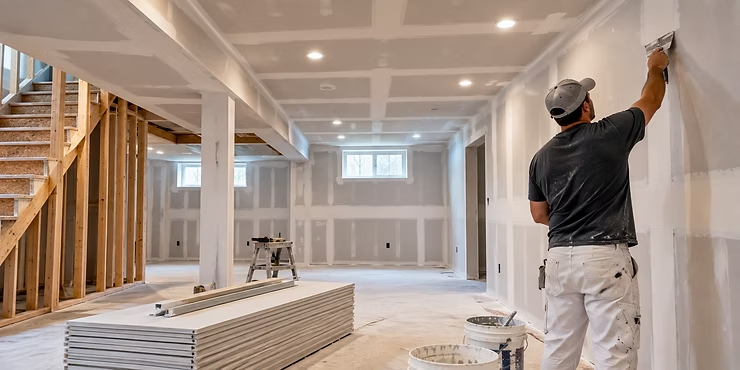
Finishing a basement is one of the best ways to turn underused space into a functional part of your home. Whether you’re planning a family room, home office, entertainment area or additional living space, proper drywall installation plays an important role in creating a basement that feels comfortable, finished and built to last.
For Toronto homeowners, however, basement renovations require more planning than simply framing walls and installing drywall. Moisture, insulation, framing, building requirements and finishing quality all need to be considered before the walls are closed.
Here’s what you should know before starting your basement renovation.
1. Start With a Dry, Healthy Basement
Before framing, insulation or drywall installation begins, existing moisture problems should be addressed.
Basements are naturally more susceptible to water infiltration because much of the space is below grade. The City of Toronto identifies foundation cracks, basement walls and windows, drainage problems, failed weeping tiles, sump-pump failures and sewer backups among the potential causes of basement flooding.
Installing new drywall over an unresolved moisture problem can lead to damaged finishes and potentially mould behind the walls. Health Canada advises that recurring mould is generally an indication that the underlying source of moisture has not been corrected, and drywall affected beneath the painted surface may need to be removed and replaced.
That makes moisture inspection an important first step before investing in a finished basement.
2. Basement Drywall Installation in Toronto Starts With Proper Framing
A quality drywall installation begins long before the first sheet of drywall goes up.
Proper framing creates the structure for straight walls, door openings, bulkheads and other architectural features throughout the basement. Poorly aligned framing can eventually become visible through uneven drywall surfaces, difficult corners and inconsistent finishes.
Planning the framing layout also gives homeowners an opportunity to determine how the finished basement will function before closing the walls.
This can include spaces such as:

- Recreation and family rooms
- Home offices
- Storage areas
- Utility rooms
- Basement bedrooms where permitted
- Entertainment spaces
Taking the time to properly plan and frame the basement helps create cleaner drywall installation and a more professional finished result.
https://www.precisiondrywallinc.ca/wood-framing
3. Don’t Overlook Basement Insulation
Insulation is another important part of a basement renovation.
Because basement walls interact with the surrounding ground and exterior environment, the wall assembly needs to be planned appropriately before drywall is installed. A properly designed insulation system can contribute to better temperature control, comfort and overall energy performance.
The important point is sequencing: framing, insulation and any required mechanical or electrical work should be properly coordinated before the drywall closes the wall cavity.
Once drywall is installed and finished, correcting work behind it becomes considerably more disruptive.
4. Choose the Right Drywall for the Space
Not every area of a basement necessarily has the same requirements.
Standard drywall may be suitable for many finished living areas, while particular locations may require different materials or assemblies depending on moisture exposure, fire-resistance requirements and how the space will be used.
This is one reason homeowners should avoid approaching basement drywall as simply covering every framed wall with the same material.
The intended use of the room, surrounding conditions and applicable building requirements should all be considered when selecting materials.
5. Professional Taping and Mudding Makes the Difference
Installing drywall panels is only part of creating a finished wall.
Once the boards are secured, joints, corners and fasteners need to be properly taped and finished with joint compound. Multiple stages of application, drying and sanding are typically required to create a smooth surface ready for primer and paint.
Poor finishing can leave behind:
- Visible seams
- Uneven joints
- Rough corners
- Screw or fastener marks
- Excessive sanding marks
- Inconsistent surfaces visible after painting
https://www.precisiondrywallinc.ca/drywall-taping
Good taping and mudding should make the individual drywall sheets effectively disappear into one continuous finished surface.
For homeowners investing in a complete basement renovation, this finishing stage can make a significant difference in how professional the final space looks.
6. Determine Whether Your Toronto Basement Renovation Requires a Permit
Not every basement finishing project in Toronto requires a building permit, but many renovations do.
According to the City of Toronto, finishing a basement in a house generally does not require a building permit when there are no structural or material alterations, no additional dwelling unit is created and no new plumbing is installed.
A permit may be required when the renovation involves structural or material alterations, new or modified heating or plumbing systems, foundation work, underpinning, a new basement entrance or the creation of a second suite.
Requirements therefore depend on the scope of the renovation rather than simply whether drywall is being installed.
Homeowners planning substantial basement alterations should confirm applicable requirements with the City of Toronto before construction begins.
7. Think About Flood Protection Before Finishing the Basement
Toronto homeowners should also consider flood protection before investing heavily in finished basement walls, flooring and furnishings.
The City notes that every home can potentially experience basement flooding and recommends measures such as addressing foundation leaks, maintaining drainage systems and considering sump pumps and backwater valves where appropriate.
As of May 1, 2026, Toronto’s expanded Basement Flooding Protection Subsidy Program provides eligible homeowners with subsidies of up to $6,650 per property toward qualifying measures including home plumbing assessments, backwater valves and alarms, sump pumps with alarms and battery backup, and certain storm-sewer or weeping-tile work.
Taking care of these issues before completing new drywall can help protect the investment being made in the basement.
Build the Basement Properly From the Inside Out
A successful basement renovation isn’t just about what you see when the project is finished.
The quality of the framing, insulation, drywall installation and finishing behind the final coat of paint all contribute to how the space looks and performs over time.
Planning these stages together can also reduce unnecessary rework and help create a basement that feels like a natural extension of the rest of the home.
Professional Basement Drywall Services in Toronto & the GTA
https://www.precisiondrywallinc.ca/contact-us
Precision Drywall provides professional drywall installation, framing, insulation, taping and mudding services for residential renovation projects throughout Toronto and the Greater Toronto Area.
Whether you’re finishing an unfinished basement or renovating an existing space, our team can help deliver clean installation, smooth finishes and dependable workmanship from framing through the final drywall finish.
Planning a basement renovation? Contact Precision Drywall today to discuss your project and request a quote.